What Is an AI-Native Agency? (And How to Spot a Real One)
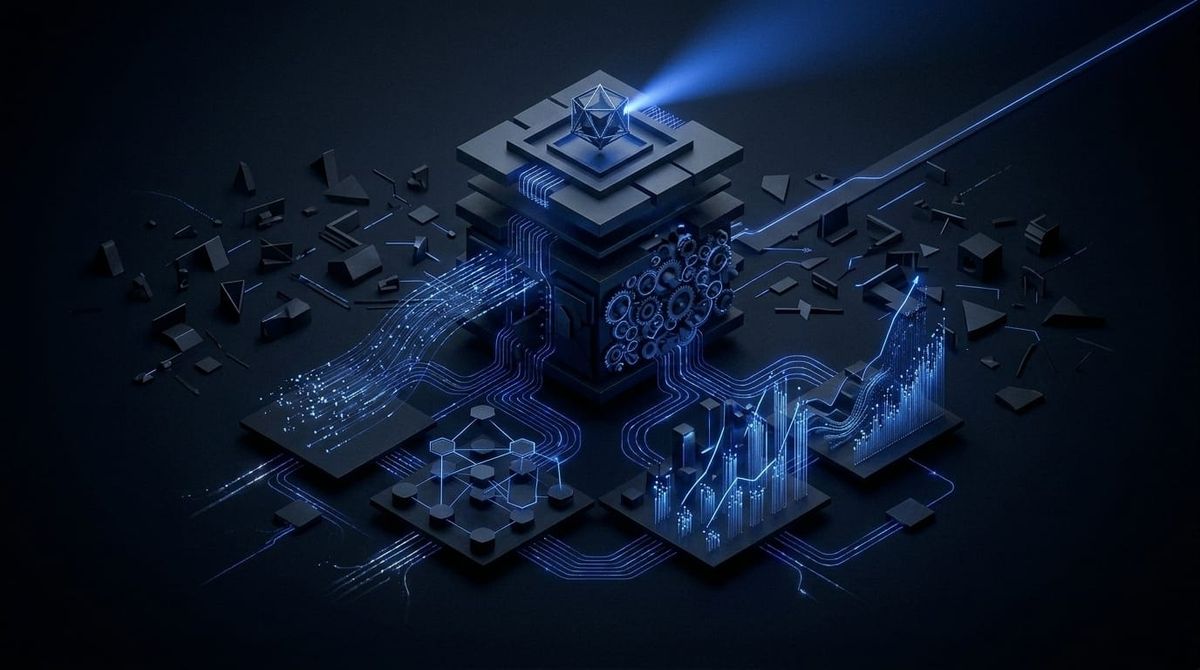
An AI-native agency isn't a traditional agency that bought ChatGPT. It's an agency rebuilt around a machine that does the production work — pulling the numbers, reading what's working, drafting the ads, writing the emails, chasing the dropped follow-up — while the owner sells judgment and outcomes. The test is simple: if you unplugged the machine, would the agency stop running? In a real AI-native agency, the answer is yes, because the machine is the agency. In a bolted-on one, a person still does everything and the AI just helps them do it slightly faster.
I was the guy AI was supposed to replace.
I ran a marketing agency — the exact kind of shop every headline in 2026 says is about to get automated out of existence. So I did the only thing that made sense to me. I built the machine instead. And I still own the agency.
That's the short version of what "AI-native" means to me, and it's almost nothing like the way the term gets thrown around. Search the phrase and you'll get a dozen listicles defining it by which tools a company owns. That's not it. So let me give you the straight answer — what an AI-native agency actually is, how to tell a real one from a costume, and what it looks like on a normal Tuesday.
What is an AI-native agency?
An AI-native agency is one where the machine does the work and the owner runs the machine. The daily production — performance pulls, reading the signal, drafting creative, writing the sequences, watching the funnel, catching the follow-up that fell through the cracks — runs as a system, not as a to-do list a human grinds through at midnight.
The word that carries the whole thing is native. A traditional agency is built around human execution: people do the work, and AI shows up as a faster way to do the same tasks they were already doing. An AI-native agency is built around the opposite assumption — that the system does the work, and the people exist to point it, judge it, and sell it. One treats AI as a tool in the toolbox. The other treats it as the floor the whole business stands on.
That distinction sounds academic until you watch what it does to the economics. When the production is human, your agency's ceiling is your team's hours. When the production is a machine, the ceiling moves — and you stop selling hours, because you don't have to.
What's the difference between an AI-native agency and one that just uses AI tools?
Here's the direct answer: a tools-user bolts AI onto a shop built to sell hours. An AI-native agency rebuilds the floor plan around the machine — same technology, completely different building.
I keep coming back to one analogy. When factories first got electric motors, they bolted them onto the old steam-era floor plan — one giant motor sitting where the steam engine used to be, spinning the same overhead shafts — and got almost nothing out of it for decades. The payoff didn't arrive until someone redesigned the entire factory around small motors at every station. Same invention. Decades between having it and winning with it. The gap was architecture, not adoption.
That's your agency with a ChatGPT subscription. A prompt here, an AI writing tool there, a chatbot on the site — bolted onto a business still built to sell hours. Nothing compounds, because the underlying floor plan never changed.
And here's the uncomfortable part: nearly every agency has now "adopted AI." Almost none have changed because of it. Adoption was never the hard part. Rebuilding around it is.
What does an AI-native agency look like day to day?
This is where the definition stops being theory. So let me show you mine running.
Before I wake up, the machine has already read every ad account, the revenue, every client conversation, and the funnel — and compressed it into one brief with the decisions pre-queued. I wake up to decisions, not data. That's a normal morning, not a demo.
A few examples of what "the machine does the work" means in practice, all from my own account, my own money:
- A retargeting campaign that returned $8.88 cost per sale at 3.04x ROAS off a tiny warm audience — the system caught the people who'd already looked and didn't waste them.
- An ad killed at $3.02 in spend — 40 impressions, zero clicks — the same day the data said it was dead. Most agencies would've let that run for a month.
- A $300 lesson about pulling a placement off a converting campaign, turned into a permanent rule baked into the system so it never costs me that again.
None of that is a person heroically grinding. It's a system doing the unglamorous work continuously, and surfacing only the judgment calls to me. That's the tell. In an AI-native agency, the owner's calendar fills with decisions and selling — not production.
Zoom out and the same machine runs my agency and the client businesses underneath it. One of those client businesses went from $1,500 a month in boosted posts to $105K in a single month — not because a human worked harder, but because the machine underneath finally existed. Our team has managed millions in ad spend and generated 2,700+ booked calls, and that history lives in the system now, not in someone's head.
How do you know if an agency is actually AI-native?
Don't judge it by the tools it lists or the following its founder has. Judge it by the game tape.
Game tape means: show me the system doing real work, this week, in real businesses — and ideally businesses that aren't the agency's own marketing funnel. Anyone can demo a clever prompt. The question is whether the machine is load-bearing in a P&L that has actual money on the line.
So when you're trying to tell a real AI-native agency from a costume, ask three things:
- Would the business stop if you unplugged the AI? If a real one, yes. If "AI" is a marketing label on a human assembly line, no — and that's a tools-user wearing the word.
- Can they show it running on something that costs them money? Their own account, a real client, live numbers on screen. Receipts, not slides.
- Does the owner sell hours or outcomes? Native agencies stopped pricing time because time stopped being the thing they sell. (That shift is exactly the retainer model AI is quietly killing.)
If you can't get a straight yes to those, the "AI-native" badge is paint.
Can a traditional agency become AI-native?
Yes — but it's a rebuild, not a purchase. You don't become AI-native by buying more tools. You become AI-native by redesigning the agency around a machine, the same way the factories had to redesign around the motors before the payoff showed up.
That's the climb I already made, scared, with my own payroll on the line — and it's the reason I can hand the map to someone standing where I stood. There's no tool you can buy that does it for you, but there is a starting point that doesn't require betting the business. If you want the on-ramp, here's where to actually start making your agency AI-native, and here's the AI stack we actually run on.
FAQ
Is an AI-native agency the same as an "AI agency" that builds chatbots?
No. "AI agency" usually means a shop that sells AI products — chatbots, automations, agents — to clients. An AI-native agency is defined by how it operates internally: the machine runs its own delivery. The first is about what you sell; the second is about how you're built.
Does AI-native mean no humans?
No. It means humans stop doing production and start doing judgment. The machine drafts, watches, and chases; the people decide, sell, and own the relationship. Fewer hands on the assembly line, more hands on the wheel.
Is "AI-native" just hype?
The label is getting overused, which is exactly why the game-tape test matters. The substance is real — an agency where the system is load-bearing behaves completely differently on cost, speed, and ceiling than one where it isn't. Ignore the badge; look for the receipts.
Why does it matter to me as a business owner hiring an agency?
Because you've been on the call where a vendor talks a big AI game and delivers the same slow, expensive work underneath. An AI-native agency can show you the machine doing this week's actual work — and that's the difference between paying for a story and paying for a system.
There are two kinds of agencies now: the ones renting AI and the ones that are AI-native. One of them is eating the other.
If you'd rather be on the right side of that line, the whole thing starts with the same ad system the machine runs on my own account — the one I'd charge a client a monthly retainer to operate. You can own the playbook for $27. Start here.
Related reading
- AI-Native Agency vs. an Agency That Just Uses AI Tools
- What's the Difference Between 'Agentic Marketing' and Being 'AI-Native'?
I document how a real agency actually runs on an AI system — real campaigns, real spend, real numbers, updated as it happens.