Are AI Solopreneurs Replacing Marketing Agencies?
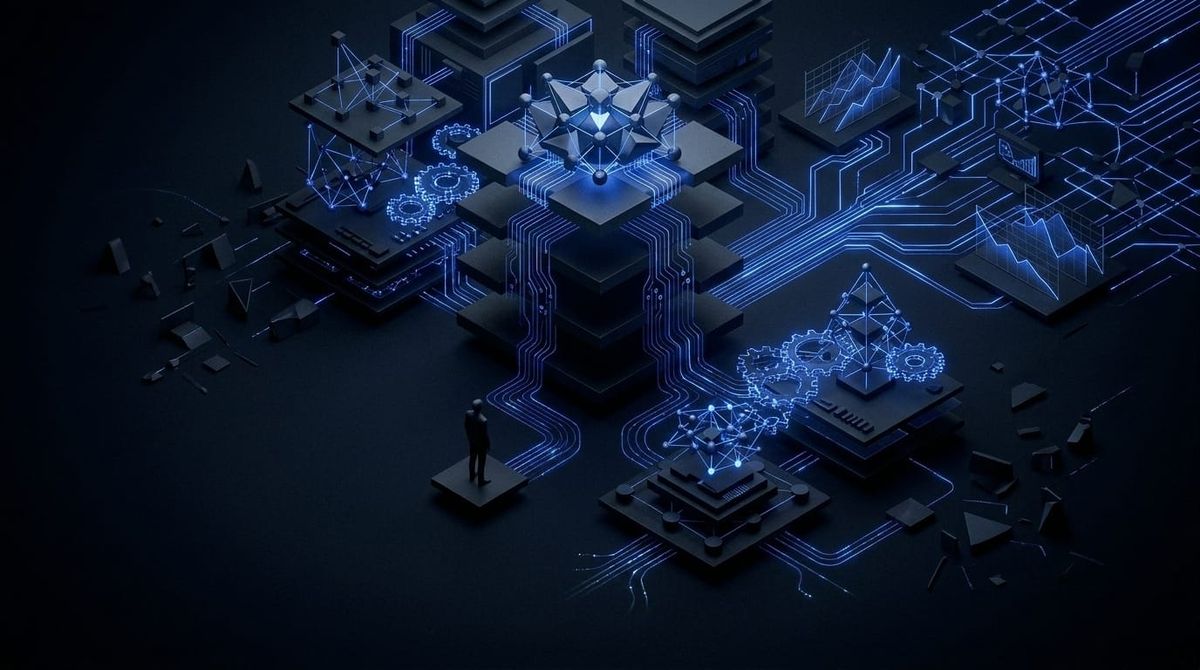
Mostly no — but with a brutal exception. AI solopreneurs are already replacing the agency that was just a set of hands: the shop that ran some ads, sent a report, and called it a service. What they can't replace is an agency that became a machine — one system running the ads, the funnel, the email, the CRM, and the reporting across several businesses at once. A solopreneur with AI has a faster tool. An AI-native agency has infrastructure one person can't operate. The ones getting eaten aren't agencies. They're middlemen.
A solo operator with a laptop and a $20-a-month AI subscription just quoted your client a price you can't touch. Same deliverables. A fraction of the cost. Delivered by Friday. If that scenario makes your stomach drop, you've already felt the thing everyone's arguing about on LinkedIn this year.
And the panic isn't imaginary. One widely-cited 2026 forecast has roughly 15% of agency jobs disappearing this year alone — not over the next decade, this year (Forrester, reported across the agency trade press). The narrative writes itself: AI made one person as productive as a small team, so the small team is dead.
I have a problem with that narrative. Not because it's wrong — because it's lazy. I was the guy AI was supposed to replace. I ran an agency, watched the model I built start to crack, and instead of pivoting to sell courses about the apocalypse, I rebuilt my own shop around the machine. I still own the agency. So let me tell you what's actually getting eaten, because it isn't what the headlines say.
Can a solopreneur with AI really do what an agency does?
The honest answer: a solopreneur with AI can now do the part of agency work that was always replaceable. Write the ad. Draft the email. Spin up the landing page. Cut a dozen creative variations before lunch. That used to take a junior team a week. Now it takes one person an afternoon. If your agency's entire value was producing those assets, yes — you have a real problem, and pretending otherwise is how you go out of business slowly and then suddenly.
I'm not romantic about this. My own shop produces at that speed on purpose. In a single afternoon we turned out 13 ad concepts and 6 finished, on-brand creatives for our own account. The production layer of marketing has collapsed in cost. That's not a threat to me — it's the floor I build on.
But here's the part the "agencies are dead" crowd skips: production was never the hard part. The hard part is everything that has to be true for that production to make money. And that's where a single person with a chatbot hits a wall.
So why aren't AI solopreneurs replacing real agencies?
Because a tool isn't a machine, and judgment isn't a prompt. A solopreneur with AI can make the asset. What they can't do is run the system that decides which asset to make, kills the ones that don't work fast enough to matter, and does it across multiple accounts at once without dropping any of them.
Let me make that concrete with my own game tape — not a survey, the actual scars.
I once killed an ad at $3.02 in total spend. Forty impressions, zero clicks. A person learning on the job — or a solopreneur juggling client work, sales, and delivery — lets that run to $50 "to give it a chance," then to $150, and learns the lesson the expensive way. The machine I run doesn't get attached. It reads the signal and pulls the trigger.
Another one: I removed a single Instagram placement from a converting campaign because its standalone cost looked ugly. It killed conversions for three days and cost about $300 before I understood why — the algorithm optimizes across placements as one system, and I'd ripped a piece out of it. That mistake is now a permanent rule baked into how we run every account. A solopreneur relearns that lesson every time, on every client, because the lesson lives in a person's memory, not in a system.
One more, because it's the whole argument in miniature: I spent $41.64 testing six "better" variations of an ad while the original — the one I almost turned off — quietly kept selling. More volume didn't win. Judgment about what to leave alone did.
Now stack that judgment across six client businesses in six different niches, plus my own, all running off one system that reads every account every morning before I'm awake. That's not a person with a faster tool. That's infrastructure. And the difference shows up in the numbers: warm-audience acquisition at $8.88 against a break-even north of $65 — roughly seven times the margin — isn't a creative trick. It's a system that knows which audience to talk to and when to stop spending on the wrong one.
A solopreneur can match my production. They cannot match my machine. One person, by definition, cannot run six businesses' full marketing operations at once. The hours don't exist. The attention doesn't exist. The accumulated judgment doesn't exist on day one.
What kind of agency actually gets eaten?
The agency that gets eaten is the one that was a middleman all along. If your business model was "I have access to ad accounts and design tools, and the client doesn't" — that arbitrage is over. AI handed the client (and every solopreneur) the same access. You were a markup on labor, and labor just got cheap.
There are two kinds of agencies now: the ones that rent AI — a chatbot bolted onto a shop still built to sell hours — and the ones that are AI-native, rebuilt around a machine that does the work while the owner sells judgment. The solopreneur with AI isn't coming for both. They're coming for the first kind. They're eating the rent-payers. And the AI-native agency is, quietly, eating everybody — including the solopreneur, because we run the same cheap production plus the system the solopreneur will never have time to build.
That's the reframe. "Solopreneurs vs. agencies" is the wrong fight. The real divide is infrastructure vs. no infrastructure. A solopreneur with AI and a generic agency are on the same side of that line — both selling fast deliverables with nothing compounding underneath. The line that matters separates anyone running a machine from everyone who isn't.
This is the same shift I've written about in the difference between an AI-native agency and one that just uses AI tools — using a tool and being built around a system are not the same business, and the gap between them is widening every month.
How do you tell which side of the line you're on?
Ask one question: if you took two weeks off, what keeps running? If the answer is "nothing — I am the system," then a solopreneur with AI is a genuine threat, because you're a solopreneur too. You just have more overhead. The fix isn't to out-hustle a 25-year-old with a laptop. You'll lose. The fix is to become the thing they can't replicate — a business with a machine underneath it instead of a person holding it together.
That's not a story I'm theorizing about. One partner came to us doing $1,500 a month in boosted posts and is now running a 15-platform integrated marketing machine — one of those months cleared $105K. The win wasn't better ads. It was infrastructure they now own, that runs whether they're on a call or on a beach.
The solopreneurs aren't killing agencies. They're killing the excuse to stay a middleman.
FAQ
Will AI replace marketing agencies entirely?
No. AI replaces the commodity layer of agency work — production and basic execution — which removes the agencies that only ever sold that layer. Agencies that own client infrastructure (the system, the data, the compounding judgment) become more valuable as production gets cheaper, not less.
Can one person with AI really run a full marketing operation?
For one small business, increasingly yes — at the cost of being permanently on call. The wall is scale and attention: a single person cannot run several businesses' full operations at once, hold the accumulated judgment that prevents expensive mistakes, or keep a system reading every account daily. That's the difference between a tool and a machine.
How do agencies compete with cheaper AI solopreneurs?
Stop competing on production price — you'll lose that race to someone with no overhead. Compete on the system: own the client's infrastructure, show a live dashboard, and make the marketing operation run without the founder. The deliverable that wins now is the machine underneath, not the asset on top.
Is it too late to make my agency AI-native?
No — most of the market is still arguing about whether to start. The playing field is unusually level right now precisely because so few agencies have actually rebuilt around a system instead of bolting a chatbot onto the old one. The window is open, but it's closing as this compounds.
What's the first move?
Map what would stop if you disappeared for two weeks, then build the system that keeps it running. Start with the highest-leverage piece — usually lead capture and follow-up — and make it operate without you before you add the next layer.
I built the machine instead of betting against my own business — and I wrote down exactly how, the same plays we run in our own shop and six others, in a $27 playbook. If you'd rather own the system than race a solopreneur to the bottom on price, start there. It's the same machine, just $27 instead of a retainer.
For the longer argument on what "AI-native" actually means, start with what an AI-native agency really is — and if you're worried this whole model dies the moment retainers do, I covered that in whether AI kills agency retainers.
I document how a real agency actually runs on an AI system — real campaigns, real spend, real numbers, updated as it happens.