
Clients Are Taking Marketing In-House Because of AI — Here's Which Agencies Survive
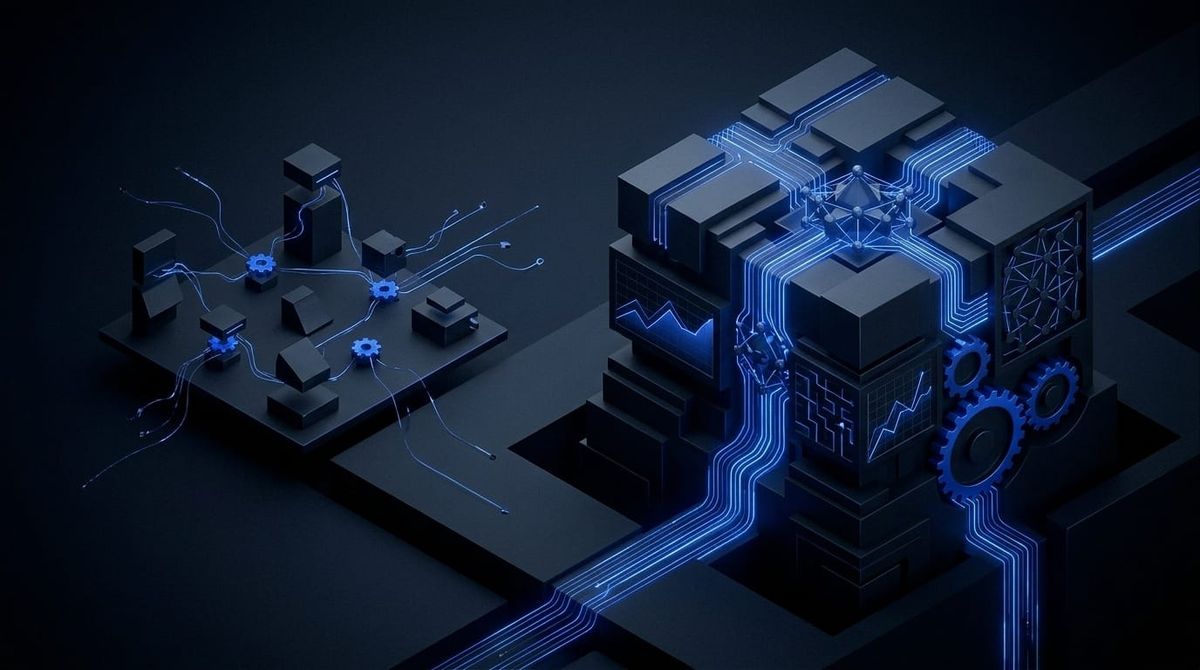
Agencies survive clients taking marketing in-house by becoming the one thing AI makes harder to replace, not easier — a working system the client would have to rebuild from scratch to fire you. The ones getting pulled in-house were renting AI: a chatbot bolted onto a shop that sells hours. The ones keeping their clients went AI-native — they run a machine the client can watch working every day, and nobody cancels the machine that runs their business.
You've been on the call where the client goes quiet.
You're walking through the report, the numbers are fine, and somewhere in the silence you can hear them doing the math. I've got ChatGPT now. My VA knows Canva. How hard can this actually be? They don't say it on the call. They say it three weeks later in an email that starts with "we've decided to bring some of this in-house."
That email is landing in more inboxes every month. Forrester projects agencies will cut roughly 15% of jobs in 2026, and the reason isn't that agencies got worse — it's that the floor under "we do things you can't" got knocked out by tools your client can now buy for twenty bucks. The question isn't whether the displacement is real. It's which agencies it actually eats.
I'll tell you straight, because I'm in the same fight you are. My money, my clients, my payroll. I was the guy AI was supposed to replace. I built the machine instead — and I still own the agency. Here's what I've learned about who survives this and who doesn't.
Why are clients suddenly taking marketing in-house?
Because AI collapsed the visible part of the work — and the visible part is the only part most agencies were ever selling. Writing a caption, spinning up a graphic, drafting an email: a client can watch AI do those in a browser tab now, and the moment they can watch it, they stop believing they should pay you four figures a month for it.
This is the trap of selling hours and deliverables. When the deliverable is a post, and a post now costs nothing, your invoice starts looking like a markup. The client isn't being disloyal. They're responding rationally to the fact that you packaged your value as output, and output is the exact thing that got commoditized first. The agencies in trouble didn't get outcompeted by another agency. They got outcompeted by a subscription.
Which agencies actually get taken in-house — and which don't?
The agencies that get pulled in-house are the ones the client could plausibly rebuild over a weekend. The agencies that keep their clients built something the client can't see the bottom of.
Think about what a client can and can't replace. They can replace a person who boosts posts — that's why "I'll just use ChatGPT" became the new "I'll just do it myself." What they can't replace is a system that's been running their numbers for nine months and knows things they don't. They can't replace the attribution that tells them which ad actually produced revenue. They can't replace the pipeline that's been quietly catching and nurturing every lead while they slept.
Here's the uncomfortable part: most agencies never built that. They ran ads and sent reports. And a client who's only ever received ads-and-reports has nothing to lose by taking it in-house — because there was never a system there to lose. There was just a vendor. Vendors get cut. Infrastructure doesn't.
Can you survive by just bolting AI onto what you already do?
No — and this is the move almost everyone makes, so it's worth killing right now. Adding a few AI tools to an agency that sells hours doesn't make you AI-native. It makes you a slightly faster version of the exact thing the client is about to do themselves.
There's a difference between an agency that uses AI tools and one that's actually AI-native, and the client feels it even if they can't name it. Bolting a chatbot onto a shop built to sell hours is like the factories that bolted electric motors onto floor plans designed for steam engines — they got almost nothing out of it for decades, because the value wasn't in the motor, it was in redesigning the whole building around it. A ChatGPT subscription stapled to your old workflow is a steam-era floor plan with a new motor in the corner.
If your client can buy the same tools you're using and get 80% of the way there, you haven't built a moat. You've handed them a tutorial.
What does an agency that can't be taken in-house actually look like?
It looks like a machine the client can watch running — doing work they could never staff for, at a depth they could never reach in-house. That's the whole game now: sell the system, not the hours.
I'll show you mine, because I run what I sell. Every morning before I'm awake, the machine has read every ad account, every dollar of revenue, every client conversation, and compressed it into one brief with decisions already queued. It killed an underperforming ad of my own at $3.02 — forty impressions, zero clicks — before a human would've finished their coffee. It rebuilt a retargeting audience server-side and pulled a sale at an $8.88 cost when the break-even was seven times higher. It found a backup that had been silently failing for forty-five days and fixed it the same morning. For one client, it wired their entire marketing stack — ad account, CRM, website behavior, project comments — into a single daily intelligence feed in one working day.
None of that is a deliverable a client can pull in-house, because it isn't a deliverable. It's an operating system that gets smarter every day it runs. The client who took $1,500/mo of boosted posts and turned it into a 15-platform integrated machine doing $105K in a single month isn't going to fire that and hand it to a VA with a prompt library. You don't cancel the thing that runs your business. You can't — it's load-bearing now.
That's the survival line. Not cheaper. Not faster. Impossible to rebuild without becoming us.
How do you start before the quiet call becomes a cancellation?
You start by accepting that the rebuild is the most important thing on your calendar right now — not a project for when client work calms down. Because it never calms down, and every month you wait, the AI-native shops compound past you while your clients sit on the quiet call doing the math.
Most owners get this backwards. They think they need to learn more AI — buy another course, save more prompts, compare more tools — before they can move. That's the slowest road there is. The real problem was never information; it's that your agency was designed before AI existed, and you can't tool your way out of a structural problem. The fix is to start turning the agency itself AI-native, beginning with the one client most likely to send that email.
You don't have to rebuild the whole thing this quarter. You have to build the first piece the client can't unsee — the dashboard, the attribution, the system underneath — so that the next time they go quiet on a call, the math comes out the other way.
The window is open right now because most agencies are still bolting motors onto steam-era floor plans. It closes the month your competitors stop.
Frequently asked questions
Is AI actually going to replace marketing agencies?
No — it's going to replace the kind of agency that only ever sold visible output. AI commoditized the deliverable, not the system. Agencies that build owned infrastructure their clients can't replicate are getting harder to fire, not easier.
My client said they can do it with ChatGPT. What do I say?
Don't argue that ChatGPT is bad — it's not. Ask what happens to their leads at 2am, who's reading their numbers every morning, and who rebuilds the system when the prompt stops working. ChatGPT is a tool. You're selling the machine the tool plugs into.
Should I just lower my prices to keep clients who are tempted to go in-house?
No. Cutting price confirms you were selling a commodity — it just makes you a cheaper commodity. The move is to raise the floor of what you deliver so the comparison stops being "you vs. a $20 subscription" and starts being "you vs. rebuilding our entire backend."
How long does it take to become the kind of agency a client can't replace?
Less time than you think, because you start with one piece, not the whole rebuild. The first visible system — real attribution, a live dashboard, a pipeline that runs without them — can land in days. The compounding intelligence is what takes months, which is exactly why you start before the quiet call, not after.
Isn't this just a bigger version of the same agency model?
No. The old model rented clients results and kept them dependent on you. This one builds a system the client owns and can see — which sounds like it should make you more replaceable, but does the opposite. The deeper the system runs in their business, the more catastrophic it is to rip out. Depth is the moat.
I built my machine scared — watching the same headlines you're watching, doing the same math my clients were doing. That's exactly why it works. The whole thing started as a $27 system I built for my own agency before I'd sell anyone anything: you can see what that looks like here. Not a course. The system itself, for the price of lunch.
There are two kinds of agencies now: the ones renting AI and the ones that are AI-native. One of them is eating the other. Pick your side while it's still your choice — not your client's.
I document how a real agency actually runs on an AI system — real campaigns, real spend, real numbers, updated as it happens.